
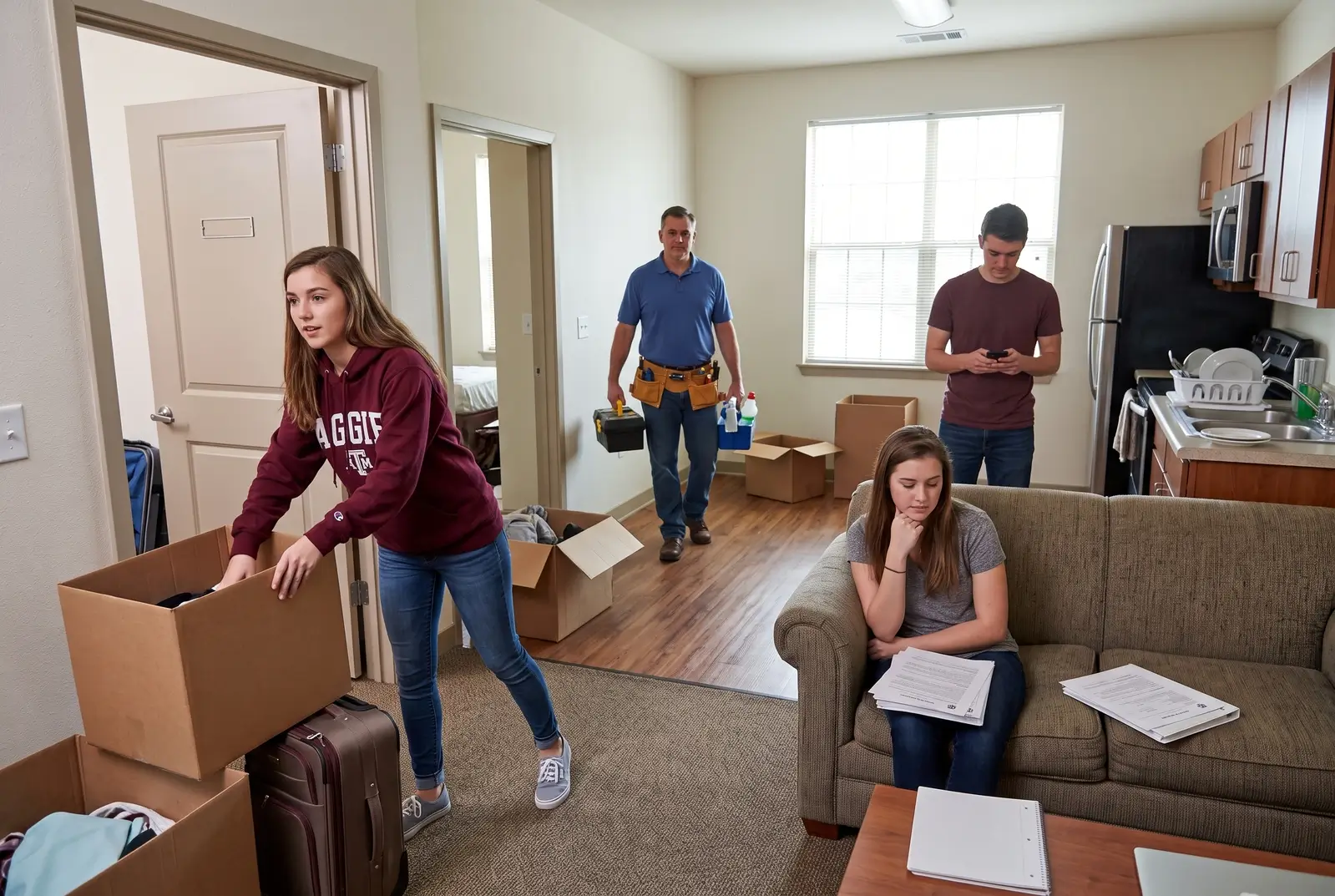
One Roommate Skips Out. Does Everyone Else Still Owe Rent?
A junior at Texas A&M packs up her bedroom mid-semester and stops answering texts. Her three roommates are still living in the unit, rent is due Friday, and nobody in the office is sure whose signature actually covers the shortfall.
For property owners renting to students in Bryan-College Station, that scenario plays out every single semester — and the answer depends entirely on how the lease was written.
TXC Realty Property Management & HOA Services brings more than 30 years of combined experience managing rental properties across College Station, Bryan, and the greater Brazos Valley, and this guide breaks down exactly how by-the-bedroom leases, guarantor agreements, and the infamous August "turn" actually function for landlords in Aggieland.
Key Takeaways
Individual liability isolates rent risk. In a true by-the-bedroom lease, one roommate's default doesn't obligate the others to cover the missing rent.
Guarantors are capped at their own student. A parent or guardian guarantor backs only their tenant's obligations, not the entire apartment's rent.
Common area damage still gets split. Shared-space repairs are typically divided equally among a unit's residents unless fault is clearly proven.
The August turn runs on a brutal 14-to-20-day clock. Standard Aggieland leases end July 31 and restart mid-August, leaving almost no margin for error.
Security deposits are calculated per bedroom, not per unit. Texas law gives landlords 30 days from surrender to refund or itemize deductions — and that calculation must be done individually.
The By-the-Bedroom Lease and Liability Matrix
Unlike a conventional per-unit lease, where every signer is on the hook for the full rent, the by-the-bedroom (individual liability) model is now the dominant framework for purpose-built student housing near Texas A&M University. Each resident signs for a specific bedroom — Bedroom B, for example — plus an undivided shared interest in the common areas.
For landlords running multiple student properties, knowing exactly where that liability starts and stops determines how clean each turnover and each collection conversation will be. TXC Realty structures its property management services around this distinction from the first day of the lease term.
Financial Isolation Protects Remaining Roommates
Under a true individual liability lease, each tenant owes only their own rent and their share of individual utility allocations. If one roommate defaults or moves out early, the remaining tenants aren't liable for that missing portion — the landlord pursues the departing tenant and their guarantor directly.
That isolation is exactly why by-the-bedroom leasing appeals to risk-conscious owners, but it also means rent collection has to be tracked resident by resident, not unit by unit.
Common Area Damage Still Gets Split
Bedroom damage bills are sent directly to the responsible occupant. Shared spaces are murkier. Texas student leases typically split kitchen, living room, and common-area damage equally among all residents of a unit, unless one tenant admits fault or the evidence clearly points to a single party. That's one more reason detailed move-in and move-out documentation matters as much as the lease language itself.
The By-the-Unit Alternative
Some traditional single-family homes and duplexes near Southwood Valley or Northgate still use conventional leases, in which every roommate — and every guarantor — bears joint and several liability for the full rent and all property damage, regardless of any private roommate agreement.
Owners weighing which model fits a given property should factor in how much collection exposure they're willing to carry, and how quickly eviction protection becomes necessary if a shared-liability tenant stops paying.
Guarantor Mechanics and the Legal Safety Net
Most student tenants have thin credit files and inconsistent income, so student housing providers almost universally require a qualified guarantor — typically a parent — to co-sign the lease.
Why the Guaranty Agreement Matters
Under Texas law, a guarantor signs a separate, legally binding guarantee agreement tied directly to the lease's financial obligations. If the student defaults on rent, damages the unit, or incurs legal fees, the landlord can pursue the guarantor for payment without first exhausting all remedies against the student.
That's a meaningful protection, but only if the guaranty paperwork is airtight from the start — which is one reason guarantor verification runs alongside TXC Realty's broader tenant screening process.
Scope Limits on What a Guarantor Backs
In a by-the-bedroom property, a guarantor's liability is capped at their own student's financial obligations. They do not cover the rent or damages caused by other roommates in the unit — a detail that surprises many first-time parent guarantors and one worth spelling out clearly before signatures are collected.
Screening Guarantors the Right Way
Landlords generally require guarantors to clear real income and credit thresholds — commonly verified monthly income of three to four times the bedroom's rent, plus a solid credit history. When a student can't provide a qualifying guarantor, most property managers require prepayment of the final two months' rent or enrollment in a security-deposit alternative program.
Pairing strict guarantor screening with a placement guarantee reduces turnover risk further, which is part of why TXC Realty backs qualified placements with its own tenant guarantees.
Executing the Aggieland August Turn
The "turn" is the highly synchronized stretch in late July and early August when thousands of Aggies move out, units get fully flipped, and new residents move in ahead of the fall semester at Texas A&M University.
A 14-to-20 Day Window, No Exceptions
Standard Aggieland leases end around July 31, with new leases starting between August 15 and 20. That leaves property teams a window of just 14 to 20 days to inspect, clean, paint, repair, and prep every bed across a portfolio — a timeline that punishes any delay in vendor scheduling or inspection turnaround.
Managing Partial Turns Without Disrupting Renewers
By-the-bedroom leasing further complicates the turn, since one roommate may move out while another renews and stays in place. Crews have to clean and repair common spaces and vacant bedrooms without violating the tenant’s privacy or disturbing their belongings — a coordination challenge that favors experienced, full-service maintenance teams over ad hoc contractor scrambles.
Lock In Vendors Months Ahead
Successful turns depend on logistics planning that starts long before July. Owners who see the strongest results typically have carpet cleaning, painting, and deep-cleaning vendors contracted by March or April, not scrambling for availability in the final weeks.
The 30-Day Deposit Clock, Per Bedroom
Under the Texas Property Code, landlords have exactly 30 days from the date a tenant vacates and provides a forwarding address to return the security deposit or furnish an itemized list of deductions. In a by-the-bedroom setup, that math has to be handled individually for each occupant rather than issuing a single check for the whole unit — a detail that's far easier to manage with organized accounting and reporting built for per-resident tracking.
Frequently Asked Questions
Does a guarantor ever become responsible for a roommate's unpaid rent?
No. In a true by-the-bedroom lease, a guarantor's obligation is limited to their own student's rent and damages, not the debts of other residents in the unit.
What happens to the security deposit if one roommate renews and another moves out?
Each occupant's deposit is calculated and returned separately based on their own bedroom's condition and move-out date, even though the unit itself isn't fully vacated.
Can landlords require an upfront payment instead of a guarantor?
Yes. When a student can't provide a qualifying guarantor, most College Station property managers require prepayment of the final two months' rent or enrollment in a security deposit program as an alternative safeguard.
Turn Your Next Lease Season Into a Predictable One
By-the-bedroom leasing gives landlords real protection against a single tenant's default, but only when the liability matrix, guarantor paperwork, and turn logistics are all managed with precision from day one. That's the exact system TXC Realty Property Management & HOA Services runs for owners across College Station, Bryan, and the Brazos Valley every leasing season.
Call 979.268.3200 to schedule a property management consultation, or contact us with questions before the next turn catches you off guard.